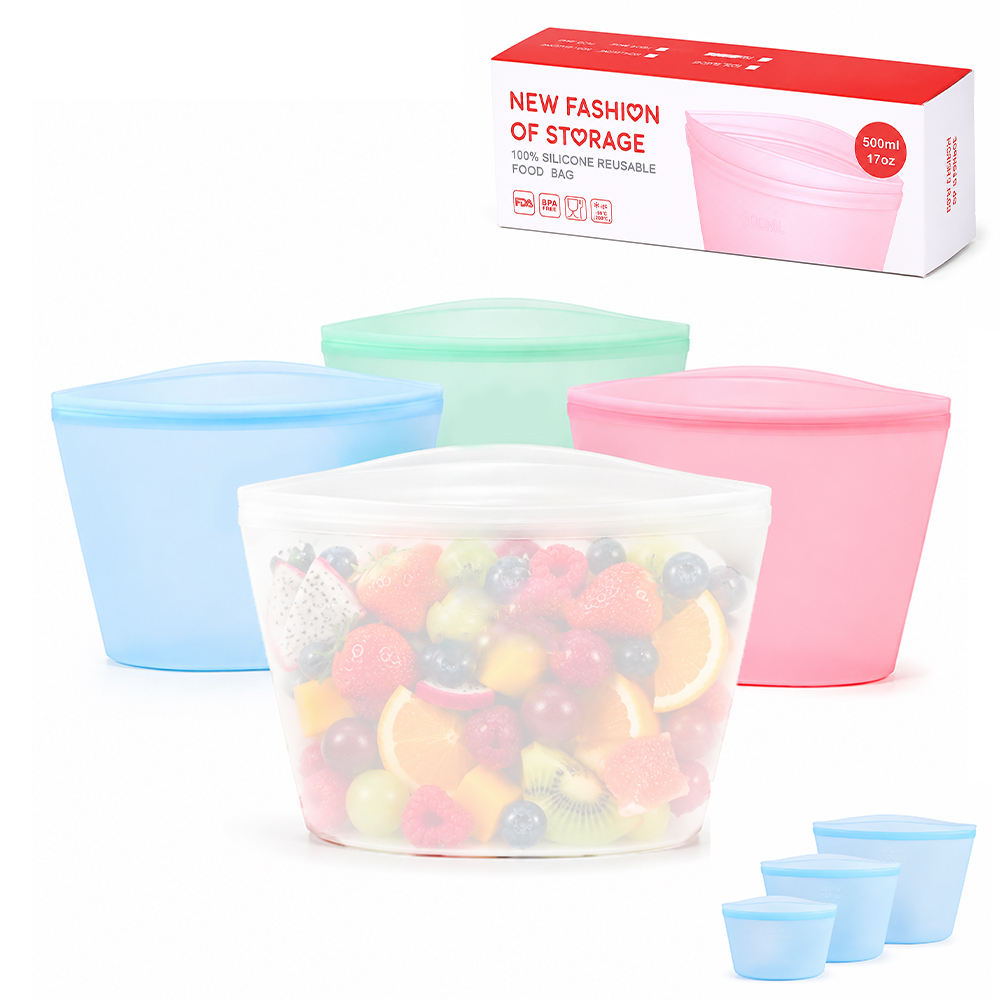
 In 2026, the food-grade silicone food storage bag has become one of the fastest-growing kitchen storage products in our product line. Across our sales channels, sample requests, B2B discussions, private-label negotiations, and OEM/ODM development projects, this product series recorded an 80% year-on-year growth signal. This figure reflects the increase observed in our own commercial channels, not a public global market statistic. The reason behind the demand is practical and easy to understand: households want a cleaner, smarter, reusable way to portion ingredients, store leftovers, organize refrigerator space, and reduce dependence on disposable fresh-keeping bags.
Our food-grade silicone food storage bag is designed for real kitchen life. It can be used for refrigerator ingredient portioning, freezer storage, lunch preparation, snack separation, fruit and vegetable organization, leftover sealing, travel food packing, pantry sorting, and meal-prep routines. Compared with thin disposable plastic bags, a reusable silicone bag gives consumers a more durable, washable, and visually organized storage solution. It also creates a stronger product story for online sellers, supermarkets, kitchenware brands, sustainability-focused retailers, and private-label home organization brands.
The reusable packaging direction is already visible in broader market research. Grand View Research reports that the global returnable packaging market was valued at USD 128.9 billion in 2025 and is projected to grow from USD 136.5 billion in 2026 to USD 206.2 billion by 2033, with a CAGR of 6.1%. Industrial returnable packaging is not the same as household silicone food bags, but the direction is relevant: repeated-use, reusable, and returnable packaging models are becoming more important across food, beverage, consumer goods, and logistics ecosystems.
WHY REUSABLE FOOD STORAGE BAGS ARE BECOMING A KITCHEN ESSENTIAL
Traditional kitchen storage often depends on disposable fresh-keeping bags, plastic wrap, loose boxes, and random containers. These products are convenient, but they create clutter and repeated purchasing costs. A household may use disposable bags for chopped vegetables, marinated meat, snacks, fruit, leftovers, frozen dumplings, bread, lunch portions, and kids’ school food. After one use, many of these bags are thrown away. Over time, this becomes a daily habit that creates both waste and cost.
A food-grade silicone storage bag changes that routine. The user can wash it, dry it, and reuse it many times when the product is used correctly. The bag is flexible enough to fit into refrigerator drawers, freezer shelves, lunch totes, and kitchen cabinets. It can stand or lie flat depending on the design. It can also be made transparent or semi-transparent so users can see ingredients quickly. For busy families, this means less food hidden in the back of the fridge and fewer forgotten leftovers.
The strongest selling point is not only “eco-friendly.” The strongest selling point is everyday convenience: reusable, washable, sealable, space-saving, portion-friendly, and easy to organize. Sustainability brings emotional value, but practical convenience drives repeat use.
A REUSABLE ALTERNATIVE TO DISPOSABLE FRESH-KEEPING BAGS
UNEP has published work on single-use plastic products and alternatives using a life-cycle approach, emphasizing that alternatives should be assessed by real use patterns and overall environmental performance, not by simple marketing claims. This matters because a reusable product creates value only when users actually reuse it many times.
That is why our silicone food storage bag is positioned as a reusable replacement for disposable fresh-keeping bags, not as a product that should be bought and forgotten. The value comes from repeated use. A consumer can use the same bag for chopped onions today, washed berries tomorrow, frozen soup next week, or travel snacks during the weekend, provided the bag is cleaned, dried, and used according to food safety guidance.
For OEM/ODM clients, this creates a strong brand message: replace repeated single-use habits with one reusable kitchen storage system. The message is clear, practical, and easy to demonstrate. Show a drawer full of disposable bags, then show a set of reusable silicone bags in different sizes and colors. The difference is immediate.
REFRIGERATOR INGREDIENT PORTIONING: THE REAL DAILY PAIN POINT
The refrigerator is one of the most chaotic places in the kitchen. Loose vegetables, open cheese, half-cut lemons, leftover rice, marinated chicken, sliced fruit, frozen dumplings, chopped herbs, and snacks often sit in mismatched containers. Some packages are too large. Some containers take too much space. Some foods are not sealed well. Some ingredients are forgotten until they spoil.
Our silicone food storage bag is designed to solve this problem through portioning. Users can divide ingredients into meal-sized portions before storing them. For example, one bag for chopped vegetables, one for washed fruit, one for marinated meat, one for leftovers, one for snacks, and one for freezer ingredients. This makes cooking faster because the user can take out exactly what they need.
USDA FSIS advises that refrigerators should be kept at 40°F or below, and raw meat, poultry, and seafood should be stored in sealed containers or wrapped securely to prevent raw juices from contaminating other foods. USDA FSIS also advises covering leftovers, wrapping them in airtight packaging, or sealing them in storage containers to help keep bacteria out, retain moisture, and prevent leftovers from picking up odors from other foods in the refrigerator.
A silicone storage bag cannot replace safe temperature control, proper cooking, or correct food handling. But it can help users store food in a more organized, sealed, and separated way. That is why it fits real kitchen routines so well.
KITCHEN ORGANIZATION: FROM MESSY FRIDGE TO VISIBLE STORAGE SYSTEM
A good food storage product should not only seal food. It should help people see and manage what they already have. When ingredients are visible and portioned, meal planning becomes easier. When bags are stackable or flat, refrigerator drawers look cleaner. When each size has a purpose, the user wastes less time searching for food.
This is one reason our silicone food bags work well in sets. A small bag can hold snacks, lemon slices, baby carrots, garlic, ginger, nuts, or sauce portions. A medium bag can hold chopped vegetables, fruit, leftover rice, pasta, meat slices, or sandwiches. A large bag can hold meal-prep ingredients, frozen vegetables, bread, dumplings, or bulk food portions. A multi-size set gives the consumer a complete fridge organization system.
For brands, sets create better selling value than single pieces. A 4-piece refrigerator organization set, 6-piece family meal-prep set, or 8-piece freezer storage set can be positioned for different users. OEM/ODM customers can customize size combinations, color coding, capacity marks, packaging layout, and product names according to target channels.
FOOD WASTE REDUCTION STARTS WITH BETTER STORAGE HABITS
EPA advises households to prevent wasted food by planning purchases, buying the amount needed, and storing food properly in airtight, labeled containers. EPA also notes that preventing food from going to waste in the first place is the best option for reducing environmental impacts.
Our silicone food storage bag supports this behavior. It can be labeled, color-coded, and used to separate ingredients by date or meal plan. One bag can be marked for Monday soup vegetables. Another can hold ingredients to freeze first. Another can hold school snacks. This makes food easier to see and use before it spoils.
The product does not magically prevent food waste. Food can still spoil if stored too long, kept at unsafe temperatures, or mixed improperly. But a good storage system reduces friction. It helps people portion, label, seal, refrigerate, freeze, and organize. In real households, reducing friction is what changes behavior.
FOOD-GRADE SILICONE: A MATERIAL STORY BUYERS CAN UNDERSTAND
Food-grade silicone is attractive because it suggests a cleaner, more durable, food-storage-oriented material choice. However, the phrase must be used responsibly. FDA provides regulatory resources for food packaging and food contact substances, and eCFR 21 CFR 177.2600 provides a framework for rubber articles intended for repeated use in producing, manufacturing, packing, processing, preparing, treating, packaging, transporting, or holding food, subject to the section’s provisions.
For our product, this means food-grade positioning must be supported by material selection, testing, documentation, labeling, and correct usage instructions. A serious brand should not simply print “food grade” on packaging. It should define the temperature range, food contact conditions, cleaning method, freezer compatibility, dishwasher guidance if applicable, and warning instructions such as avoiding open flame or sharp knives inside the bag.
Our company supports OEM/ODM clients with material selection, hardness, thickness, color, closure design, odor control, testing requests, packaging claims, and multilingual instructions. This is especially important for buyers selling in regulated markets, supermarkets, Amazon, TikTok Shop, European e-commerce, and B2B distribution.
REUSABLE DOES NOT MEAN CARELESS: CLEANING AND DRYING MATTER
A silicone food storage bag is reusable only if users clean and dry it properly. After holding oily food, sauce, meat marinade, fruit juice, or leftovers, the bag should be washed thoroughly and dried before storage. If a wet bag is folded and closed, moisture can remain inside. That may lead to odor, residue, or poor user experience.
This is why design matters. A wide opening makes washing easier. Rounded inner corners reduce hard-to-clean dead spots. A stable base can help the bag stand for filling and drying. A strong seal should close securely but remain easy to open. A smooth internal surface can help reduce residue retention. These details decide whether the consumer actually reuses the bag long-term.
For OEM/ODM development, we can customize the opening width, bottom shape, thickness, internal radius, zip seal, slider seal, pinch seal, hanging hole, measurement marks, matte or glossy texture, and packaging instructions. A reusable product succeeds only when it is easy to reuse.
FREEZER STORAGE AND MEAL PREP: TWO HIGH-VALUE SCENARIOS
Freezer storage is one of the most practical uses for silicone food bags. Consumers can portion soup, fruit, dumplings, vegetables, herbs, bread, meat, or leftovers. A flexible bag can take less space than rigid containers, especially when laid flat. When food is frozen in thinner portions, it may also be easier to stack and organize.
Meal prep is another major selling point. Working families, fitness users, students, office workers, and parents often prepare ingredients ahead of time. Silicone bags can help divide proteins, vegetables, snacks, breakfast items, and sauces into daily portions. This makes weekday cooking faster and reduces the chance of ordering takeout because ingredients are already prepared.
The product can also be marketed as a fridge-to-freezer organization system, meal prep storage bag, reusable freezer bag, snack storage bag, and kitchen portioning bag. These terms give sellers more SEO angles and allow a single product to serve multiple customer groups.
AIRTIGHT SEALING AND ODOR CONTROL IN THE REFRIGERATOR
One of the biggest complaints about refrigerator storage is odor transfer. Onions, garlic, cooked meat, cheese, leftovers, sauces, and seafood can affect nearby foods if not sealed well. USDA FSIS specifically mentions airtight packaging and sealed storage containers as ways to help keep bacteria out, retain moisture, and prevent leftovers from picking up odors from other foods in the refrigerator.
A silicone food storage bag should therefore focus strongly on seal performance. The closure must be reliable, easy to align, and durable after repeated opening and closing. If the seal is weak, the product loses its main value. If the seal is too hard to close, users stop using it. The best design balances tightness and convenience.
For OEM/ODM customers, we can develop different sealing structures: zip-lock style, slider closure, pinch seal, double-seal ridge, stand-up bottom, flat freezer shape, or leak-resistant lunch storage design. The target market decides the best structure. A freezer storage bag may need a strong wide seal; a snack bag may need quick open-and-close convenience; a lunch bag may need a more secure closure.
WHY SILICONE BAGS ARE STRONG FOR E-COMMERCE
DHL’s 2026 E-Commerce Trends Report is based on 29,000 online shoppers and 5,800 e-commerce businesses across 29 countries, showing how broad and active global e-commerce behavior has become. Products with clear visual benefits perform well because consumers can understand them quickly through images and videos.
Silicone food storage bags are highly visual. Sellers can show disposable bags being replaced by reusable silicone bags. They can show fridge drawers before and after organization. They can show chopped vegetables stored by meal. They can show freezer stacking. They can show water filling and sealing demonstrations. They can show the bag being washed, dried, and reused.
This makes the product suitable for Amazon, TikTok Shop, AliExpress, Shopee, Lazada, Ozon, Wildberries, Shopify, supermarket e-commerce, private-label kitchenware stores, and sustainable home goods brands. The product solves a problem that people can see in their own fridge.
LIVE COMMERCE: THE PRODUCT SELLS THROUGH DEMONSTRATION
McKinsey reports that live commerce can achieve conversion rates up to ten times higher than conventional e-commerce in certain contexts. This matters because reusable silicone food bags are easy to demonstrate live: fill, seal, shake, store, freeze, rinse, and reuse.
A live host can compare disposable plastic bags with silicone bags, show how much food each size holds, pour water inside to demonstrate sealing, place the bags into a refrigerator drawer, and show how they stack. The audience immediately understands the value. The product is practical, visual, low-barrier, and easy to bundle in sets.
For sellers, this means strong short-video and live-stream potential. The product can be sold as a kitchen storage solution, eco-friendly alternative, meal-prep tool, freezer organizer, lunch packing accessory, or private-label family storage set.
OEM CUSTOMIZATION: BUILD YOUR OWN FOOD STORAGE BRAND
Our company supports full OEM customization for food-grade silicone food storage bags. We can customize logo, color, size, capacity, shape, seal structure, thickness, silicone hardness, transparency, surface texture, measurement marks, date labels, hanging hole, packaging, barcode, multilingual instructions, e-commerce box, retail display box, kraft paper packaging, gift set, and private label.
OEM should follow the target sales channel. For Amazon, strong images and size comparison charts are essential. For TikTok Shop, visible sealing and fridge organization videos matter most. For supermarkets, packaging must clearly explain size, use, cleaning, and reuse. For sustainability stores, the story should focus on replacing repeated single-use habits. For baby and family channels, food contact documentation and clear cleaning guidance become more important.
We help clients turn a basic silicone bag into a complete branded product line. That includes product design, packaging language, set planning, visual selling points, and market positioning.
ODM DEVELOPMENT: MORE THAN ONE BAG SIZE
ODM allows deeper product development. We can design stand-up food storage bags, flat freezer bags, snack bags, sandwich bags, fruit bags, baby food portion bags, soup freezer bags, travel snack bags, lunch bags, transparent fridge bags, color-coded meal prep bags, and premium thickened silicone storage sets. Each version can target a different user and price point.
The development should start from real use. If the target is freezer storage, the bag should lie flat, seal tightly, and be easy to label. If the target is refrigerator organization, transparent or semi-transparent design is important. If the target is baby food, smaller portion sizes and clear safety instructions matter. If the target is bulk storage, thickness and seal strength become more important. If the target is live commerce, the product must show its function clearly on camera.
ODM turns one product concept into a full kitchen storage system.
QUALITY CONTROL: ODOR, SEAL, THICKNESS, FLEXIBILITY, AND BATCH CONSISTENCY
Food storage products require strict quality control because they come close to food. Consumers notice odor immediately. If the silicone smells strong, trust drops. If the seal leaks, the product fails. If the bag is too thin, it feels cheap. If it is too thick, it may be hard to fold or store. If the opening is too narrow, cleaning becomes difficult. If colors vary between batches, the brand image becomes unstable.
We control material odor, silicone thickness, hardness, elasticity, seal performance, closure durability, transparency, color stability, internal surface finish, logo clarity, packaging protection, and batch consistency. For B2B buyers, one perfect sample is not enough. Every production batch must match the approved sample.
This is especially important for private-label brands. Online reviews can be damaged by leakage, odor, weak seals, or poor packaging. Stable production protects ratings, reduces returns, and supports repeat orders.
WHY BUYERS SHOULD LAUNCH THIS PRODUCT IN 2026
The 80% growth signal in our channels shows that buyers are responding strongly to reusable kitchen storage products that combine sustainability, organization, food portioning, and e-commerce demonstration value. Grand View Research supports the broader growth direction of returnable packaging. UNEP’s work on single-use plastic alternatives reinforces the importance of real reuse instead of disposable habits. EPA emphasizes airtight and labeled storage to help reduce wasted food at home. USDA FSIS supports sealed leftovers and safe refrigerator practices. FDA and eCFR provide the regulatory background for food contact substances and repeated-use rubber articles. DHL and McKinsey show why visually demonstrable products can perform well in e-commerce and live commerce.
Our food-grade silicone food storage bag brings these trends together in one product: reusable alternative to disposable fresh-keeping bags, refrigerator ingredient portioning, freezer storage, meal-prep organization, airtight sealing, easy cleaning, color-coded sets, private-label potential, and complete OEM/ODM customization. In 2026, consumers do not only want storage. They want a system that helps them see food, use food, protect food, reduce wasteful habits, and keep the kitchen cleaner. That is exactly the value our product delivers.
 EN
EN
