 El «aumento del 78 % en ventas» mencionado en este artículo debe atribuirse a una fuente de datos claramente definida, como los registros internos de ventas de la empresa, paneles de control de marketplaces transfronterizos o canales selectos de distribuidores.
Una declaración adecuada sería:
«Según los datos de pedidos de nuestra empresa procedentes de los principales canales de ventas transfronterizas, las ventas de cajas plegables para almacenamiento en campamentos aumentaron un 78 % de enero a junio de 2026 respecto al mismo período de 2025.»
Actualmente, ninguna organización internacional importante publica una cifra unificada de crecimiento global de ventas específicamente para cajas plegables de almacenamiento en campamentos. Por tanto, sería inexacto calificar el aumento del 78 % como una estadística oficial del mercado mundial.
Los datos internacionales citados a continuación se utilizan para verificar el crecimiento general del turismo, el campamento, los viajes por carretera y la recreación al aire libre. A continuación, se explica el crecimiento específico de las ventas de productos mediante cambios medibles en el comportamiento del consumidor, las necesidades de almacenamiento en vehículos, la vida en espacios reducidos y la demanda de equipos multifuncionales.
El mercado de equipamiento para acampar en 2026 ya no se impulsa únicamente por tendencias efímeras de las redes sociales. Los consumidores se vuelven más selectivos. Cada vez preguntan con mayor frecuencia si un producto es verdaderamente útil, si resiste un uso repetido y si reduce la presión de almacenamiento tanto dentro del vehículo como en el hogar.
Según la edición de enero de 2026 del Barómetro Mundial del Turismo de la OMT, las llegadas de turistas internacionales alcanzaron aproximadamente 1520 millones en 2025. Esto representó un crecimiento de cerca del 4 % respecto a 2024, es decir, unos 60 millones adicionales de viajeros internacionales.
No todo nuevo viajero se convierte en cliente de equipamiento para acampar. Sin embargo, el crecimiento continuo del turismo amplía la audiencia para viajes por carretera, vacaciones de acampada, alojamientos al aire libre y productos recreativos centrados en destinos.
Acampar tampoco es una actividad marginal en Europa. Eurostat informó que los huéspedes pasaron aproximadamente 413 millones de noches en campings, parques para vehículos recreativos y parques para remolques en la Unión Europea durante 2025. Estas estancias representaron el 13,4 % de todas las noches de alojamiento turístico en la UE.
En comparación con 2015, las noches pasadas en campings y instalaciones para vehículos recreativos aumentaron un 28,5 %, un incremento más fuerte que el registrado por los hoteles y muchas otras categorías de alojamiento. Solo Francia representó aproximadamente 154 millones de noches de acampada y uso de vehículos recreativos, mientras que España, Italia y Alemania registraron cada uno decenas de millones.
El informe sobre participación de la Outdoor Industry Association de 2025 también mostró que las actividades al aire libre accesibles siguieron atrayendo nuevos participantes en Estados Unidos. El senderismo, el acampamento y la pesca sumaron cada uno más de dos millones de participantes.
Estas actividades tienen barreras de entrada relativamente bajas en comparación con los deportes al aire libre altamente técnicos. Por lo tanto, es más probable que atraigan a familias, usuarios más jóvenes y consumidores primerizos de productos al aire libre. Esto genera demanda de productos asequibles e intuitivos que no requieren formación compleja ni conocimientos especializados.
El Informe sobre Acampada y Hospitalidad al Aire Libre 2025 de KOA señaló que Norteamérica ganó más de 11 millones de hogares campistas respecto a 2019. Los gastos relacionados con la acampada alcanzaron aproximadamente USD 61 000 millones, y cerca de una cuarta parte de los viajes recreativos incluían un componente de acampada. El informe también reveló que el 72 % de los viajeros encuestados consideraba la acampada una forma asequible de viajar.
En conjunto, estos hallazgos indican que el consumo relacionado con la acampada va más allá de las tiendas de campaña, los sacos de dormir y las estufas de cocina. Un número creciente de hogares comunes adquiere productos para la organización del vehículo, cocinas de campamento, iluminación, suministro eléctrico, almacenamiento de agua, limpieza y organización de uso general.
La caja plegable para almacenamiento en campamentos se sitúa en la intersección de tres mercados: organización automotriz, equipo para acampar y almacenamiento doméstico.
Las cajas rígidas tradicionales son estables, pero ocupan todo su volumen incluso cuando no están en uso.
Para los hogares urbanos con espacio limitado, un viaje de acampada puede durar solo dos o tres días. Sin embargo, el equipo relacionado debe permanecer guardado en casa durante semanas o meses. Si todos los contenedores son rígidos, los balcones, armarios, garajes y maleteros de los automóviles se llenan rápidamente de cajas vacías.
Una estructura plegable resuelve un problema que existe antes y después del viaje, no solo durante la actividad de acampada.
Cuando es necesario, el producto se expande hasta convertirse en una caja de almacenamiento estable. Cuando está vacío, se pliega hasta adoptar una forma relativamente delgada que puede guardarse debajo de una cama, al lado de un armario, dentro de un compartimento de maletero o encima de otro equipo.
La Caravan Industry Association of Australia informó en su revisión sectorial de 2026 que los australianos realizaron aproximadamente 17,3 millones de viajes en caravana y acampada en 2025, generando 57,9 millones de noches de visita y un gasto de 12 600 millones de AUD.
Al mismo tiempo, la duración media del viaje disminuyó a aproximadamente 3,4 noches. Los consumidores eligieron cada vez más viajes más cortos y cercanos a su lugar de residencia, y otorgaron mayor importancia a la flexibilidad y al valor.
Los viajes más cortos modifican las preferencias en cuanto al equipamiento. Las personas están menos dispuestas a preparar artículos excesivamente grandes y altamente especializados para un fin de semana de dos o tres días. Prefieren productos que se carguen rápidamente, se desplieguen con facilidad y vuelvan inmediatamente a un formato compacto tras finalizar el viaje.
Una caja plegable de almacenamiento se adapta a este patrón de viaje de forma más eficaz que un contenedor rígido permanente.
Uno de los mayores problemas en los viajes por carretera no es siempre la cantidad total de equipamiento, sino el número de formas distintas que se cargan en el vehículo.
Las tiendas de campaña, toldos, utensilios de cocina, vajilla, alimentos, iluminación, estaciones portátiles de energía, ropa y productos de limpieza suelen colocarse juntos en el mismo maletero. Se desplazan cuando el vehículo gira, frena o circula por carreteras irregulares.
Al llegar, los usuarios pueden necesitar un artículo enterrado en la parte inferior. Como resultado, gran parte del maletero debe descargarse antes de poder acceder al producto requerido.
Las bolsas blandas son ligeras, pero tienden a perder su forma al llenarse con utensilios de cocina, botellas, contenedores de combustible u otro equipamiento sólido. Además, resulta difícil apilarlas verticalmente.
Las cajas convencionales con apertura superior son más fáciles de apilar. Sin embargo, una vez que se colocan varias cajas una encima de otra, abrir el contenedor inferior requiere mover todo lo que está encima.
Por eso, un número creciente de cajas plegables para acampar combina actualmente una tapa superior con una o más puertas de acceso lateral.
La apertura superior resulta útil para cargar objetos grandes. La puerta lateral permite a los usuarios recuperar productos de uso frecuente mientras las cajas permanecen apiladas o situadas profundamente en el maletero.
El usuario no necesita retirar toda la caja, reorganizar el vehículo ni descargar toda la pila.
Nuestros productos pueden desarrollarse con una puerta lateral simple, con dos puertas laterales, con tapa superior o con un sistema de apertura multidireccional. Las cerraduras, bisagras, asas y puntos estructurales de conexión pueden reforzarse según la carga real y el entorno operativo previsto.
El objetivo no es añadir tantas aberturas como sea posible. Cada abertura debe resolver un problema real de acceso sin debilitar innecesariamente la caja.
Los consumidores suelen estar dispuestos a pagar más por un producto multifuncional cuando sus funciones son prácticas y no interfieren entre sí.
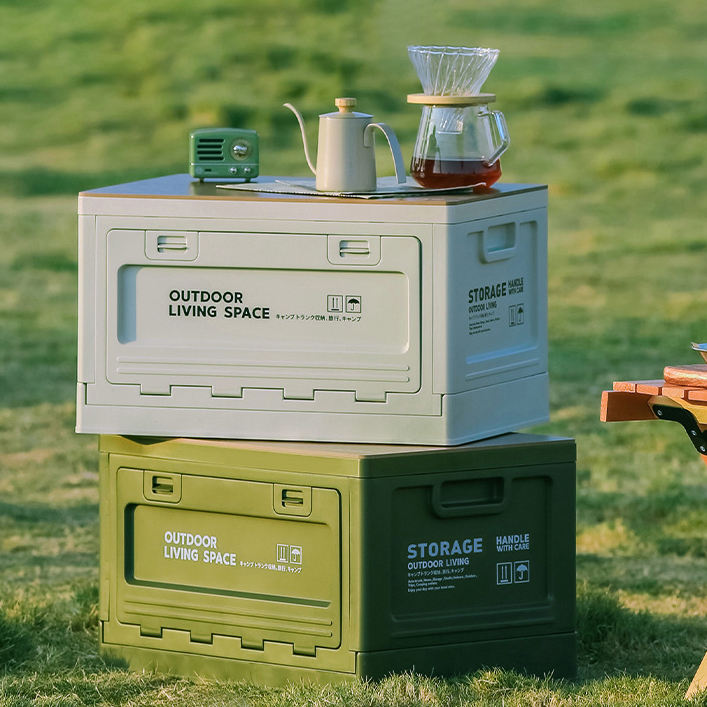
Una caja plegable para acampar, debidamente diseñada, puede desempeñar varias funciones a lo largo de su ciclo de vida.
Antes de partir, organiza el equipo de acampada en el hogar.
Durante la carga, se convierte en un organizador para el maletero.
En el campamento, almacena alimentos, utensilios de cocina, linternas, herramientas o productos de limpieza.
Con una tapa adecuadamente reforzada y sometida a pruebas, puede funcionar como mesa lateral temporal o superficie de trabajo.
Tras el viaje, puede reintegrarse al uso doméstico para juguetes, productos de limpieza automotriz, almacenamiento de comestibles o artículos estacionales.
Este valor aplicable en múltiples escenarios transforma la percepción del consumidor sobre el producto. En lugar de considerarlo un accesorio utilizado solo unas pocas veces al año, el comprador lo ve como una herramienta duradera para la organización tanto del vehículo como del hogar.
Es importante distinguir claramente entre su uso como mesa y su uso como asiento.
Una tapa estándar de caja de almacenamiento no debe promocionarse automáticamente como asiento. Las declaraciones sobre capacidad de asiento requieren una tapa reforzada, soporte interno y pruebas adecuadas de carga estática, carga excéntrica y fatiga.
Nuestros proyectos OEM y ODM pueden incluir un panel superior reforzado, características antideslizantes y soporte interno adicional. Solo después de que la estructura pase las pruebas acordadas debe comercializarse el producto con una función de asiento definida o una carga máxima especificada.
Un error frecuente al acampar en familia consiste en colocar todo el equipamiento en una sola caja de dimensiones excesivas.
En el lugar de acampada, los usuarios deben buscar repetidamente cuchillos, condimentos, luces, artículos de limpieza o cables de carga. Un enfoque más eficiente consiste en crear módulos funcionales, tales como:
Nuestros productos pueden diseñarse como una serie modular con las mismas dimensiones base pero distintas alturas o capacidades. Esto permite que varios modelos se apilen según el mismo sistema dimensional.
Los distribuidores pueden vender unidades individuales, juegos de dos piezas, juegos de tres piezas o combinaciones completas para acampar en familia.
Se pueden utilizar distintos colores del cuerpo, puertas transparentes, soportes para etiquetas, pegatinas con iconos o tarjetas identificativas intercambiables para diferenciar categorías. Los clientes OEM pueden aplicar sus propios colores de marca y su sistema gráfico.
Una caja con apertura superior funciona bien cuando se coloca directamente al lado de la puerta trasera abierta. Su uso resulta menos práctico cuando está enterrada bajo otras maletas o colocada debajo de otra caja de almacenamiento.
Un diseño con acceso lateral permite al usuario recuperar artículos más pequeños desde la parte delantera o lateral.
Para SUV, monovolúmenes, camionetas y vehículos recreativos, las dimensiones pueden desarrollarse en torno a espacios de almacenamiento comunes, de modo que la puerta de acceso quede orientada hacia el pasillo del vehículo o hacia la puerta trasera.
En proyectos ODM, podemos modificar la longitud, la anchura y la altura según los modelos de vehículo objetivo, las medidas del maletero y las disposiciones de apilamiento previstas.
También podemos desarrollar conexiones entre varias cajas o estructuras de fijación que reduzcan el movimiento durante la conducción.
Las superficies de los campings pueden contener barro, arena, hojas y charcos.
La parte inferior de la caja debe incluir, por tanto, pies adecuados, nervios o puntos de contacto elevados, para que toda la base no descanse directamente sobre el suelo.
Las esquinas y las superficies interiores deben ser fáciles de limpiar con un paño. El diseño debe evitar ranuras profundas innecesarias que retengan suciedad y humedad.
Para el almacenamiento de alimentos y vajilla, los clientes pueden seleccionar revestimientos extraíbles, divisores o bandejas internas. Los alimentos secos, los materiales de limpieza y los utensilios de cocina usados pueden mantenerse así separados.
Cualquier afirmación sobre resistencia al agua o a la lluvia debe vincularse a una prueba definida.
Una caja de almacenamiento normal con tapa puede reducir la entrada de polvo o gotas ligeras de agua, pero no debe describirse automáticamente como totalmente resistente al agua.
Según el proyecto, podemos realizar pruebas de rociado, pruebas de fugas en costuras u otras pruebas de protección acordadas antes de determinar el lenguaje comercial adecuado.
La Oficina de Análisis Económico de Estados Unidos informó que la economía estadounidense de recreo al aire libre generó aproximadamente USD 696.700 millones en valor añadido durante 2024, lo que representa el 2,4 % del PIB estadounidense.
La actividad relacionada con vehículos recreativos contribuyó aproximadamente con USD 27.500 millones, convirtiéndose así en una de las categorías convencionales más grandes de recreo al aire libre.
Los consumidores norteamericanos utilizan con frecuencia SUV, camionetas, vehículos recreativos (RV) y garajes domésticos. Suelen priorizar una alta capacidad, resistencia estructural, apilabilidad, durabilidad para viajes largos y disponibilidad de piezas de repuesto.
Las opciones de producto adecuadas pueden incluir mayores capacidades, tapas reforzadas, ruedas y dimensiones compatibles con los compartimentos de almacenamiento de los RV.
Las 413 millones de noches de alojamiento en campings y vehículos recreativos (RV) registradas por Eurostat en 2025 demuestran la madurez de la demanda europea de viajes al aire libre.
Muchos consumidores europeos utilizan automóviles compactos, station wagons o autocaravanas más pequeñas. Asimismo, el espacio residencial para almacenamiento y las dimensiones de estacionamiento también pueden ser limitadas.
Por lo tanto, los productos europeos se benefician de dimensiones plegadas compactas, formas regulares, embalaje eficiente y materiales claramente identificados.
Según los requisitos del cliente, podemos emplear sistemas de materiales simplificados, reducir piezas innecesarias de materiales mixtos y preparar instrucciones y etiquetas de seguridad en varios idiomas.
Los datos industriales australianos indican que aproximadamente 937 000 caravanas y vehículos recreativos estaban registrados en 2025, lo que representa un crecimiento anual de alrededor del 4 %. Aproximadamente el 87 % de los viajes en caravana y acampada se realizaron hacia destinos regionales.
Por lo tanto, los productos podrían enfrentar distancias de conducción prolongadas, altas temperaturas, luz solar intensa, polvo y variaciones significativas de temperatura.
El desarrollo debe considerar la resistencia climática de los materiales, la resistencia de los cierres, las vibraciones del vehículo y la estabilidad dimensional en interiores de vehículos calurosos. Las especificaciones finales deben basarse en el mercado objetivo y en las normas de ensayo acordadas.
En muchas ciudades asiáticas, las familias viven en apartamentos y utilizan automóviles compactos o SUV más pequeños.
Una caja plegable resuelve tanto los problemas de almacenamiento doméstico como los de carga en el vehículo. Capacidad mediana y pequeña, combinaciones de dos cajas y modelos que también pueden funcionar como mesas laterales en campamentos suelen ser adecuados para viajes cortos de fin de semana.
En mercados donde los centros de servicio pueden estar lejos del cliente, la reparabilidad y las piezas de repuesto adquieren especial importancia.
Una estructura sencilla, cierres compartidos, ruedas reemplazables y accesorios comunes entre varios tamaños de caja pueden ayudar a los distribuidores locales a resolver problemas posventa sin necesidad de reemplazar el producto completo.
No tratamos una caja plegable para acampar como un único producto universal.
La especificación debe reflejar el canal de ventas del cliente, el precio minorista, el tipo de vehículo y el uso previsto.
Primero, se pueden desarrollar distintas capacidades y proporciones de carrocería. La mayor capacidad no es automáticamente la mejor opción. Las dimensiones deben equilibrarse con el tamaño del maletero, el volumen del embalaje para exportación, los requisitos de los estantes comerciales y la comodidad del consumidor al levantar el producto.
Segundo, los clientes pueden elegir distintos sistemas de acceso, como apertura superior, frontal, por ambos lados o combinada (superior y lateral).
Los paneles de las puertas pueden ser transparentes, translúcidos u opacos.
Tercero, el producto puede configurarse con tapas estándar, superficies superiores tipo mesa, porta-vasos, divisores internos, bandejas extraíbles, ruedas, asas de arrastre, tarjetas etiqueta y pies antideslizantes.
Cada característica debe seleccionarse según el uso previsto y el precio objetivo. Añadir accesorios poco utilizados únicamente para incrementar el número de afirmaciones comerciales puede aumentar el riesgo de fallos y debilitar la propuesta de valor.
Para los clientes de comercio electrónico transfronterizo, el tamaño del empaque plegado es especialmente importante.
Podemos considerar el grosor plegado, la colocación de accesorios, los materiales protectores, las cajas individuales y la carga en cajas maestras durante la fase de diseño del producto.
Esto evita finalizar la fabricación de las herramientas solo para descubrir que el volumen de envío es demasiado alto para el mercado objetivo o el canal logístico previsto.
La opción OEM es adecuada para clientes que ya cuentan con un canal de ventas y desean lanzar un producto con marca propia con una inversión relativamente baja en desarrollo.
Basándonos en una plataforma de producto existente, podemos personalizar:
Los clientes pueden vender una sola caja como producto de entrada o combinar dos o tres capacidades para crear una gama modular de almacenamiento para acampar.
Por ejemplo, una caja más pequeña puede contener vajilla y condimentos, una caja mediana puede transportar una estufa y utensilios de cocina, y una caja más grande puede guardar accesorios para tiendas de campaña u otros suministros generales.
Una identidad visual coherente ayuda a los consumidores a reconocer la gama y fomenta las compras repetidas.
El desarrollo ODM es adecuado cuando los productos existentes no pueden cumplir con los requisitos dimensionales, estructurales o funcionales del cliente.
Un proyecto ODM debe comenzar con el caso de uso real, no únicamente con la apariencia.
El cliente debe proporcionar información como:
Con esta información, podemos llevar a cabo el desarrollo estructural, la modelización 3D, la prototipación rápida, la evaluación de apertura y cierre, las pruebas de apilamiento y las evaluaciones de embalaje.
Tras la aprobación de la muestra, el proyecto puede pasar a la fabricación de moldes, la producción piloto y la inspección de producción en masa.
Para sistemas modulares de almacenamiento de vehículos, podemos desarrollar distintas alturas utilizando una huella de base común. También pueden incorporarse sistemas de conexión, estructuras antideslizantes y elementos de fijación para vehículos.
Esto permite que una marca construya un ecosistema propio de almacenamiento para acampada, en lugar de vender únicamente una caja aislada.
La pregunta clave para un producto plegable no es si se abre sin problemas la primera vez. Es si la estructura mantiene su fiabilidad tras un uso repetido.
Dependiendo de la posición del producto, la verificación de calidad puede incluir:
Estas evalúan las bisagras, las líneas de plegado, los puntos de conexión y las estructuras de bloqueo tras múltiples ensamblajes y plegados.
Estas comprueban si el cierre permanece seguro y correctamente alineado tras múltiples aperturas y cierres.
Estas verifican la resistencia del cuerpo de la caja, la base y la tapa bajo cargas distribuidas y condiciones de almacenamiento apilado.
Estas simulan situaciones en las que el equipo se concentra en un solo lado o en las que se aplica presión de forma desigual sobre la tapa.
Estas evalúan los riesgos asociados a la manipulación y el transporte.
Esto verifica la deformación del material, la fragilidad, la contracción o la reducción del rendimiento de bloqueo ante cambios de temperatura.
Estas pruebas verifican si el producto puede soportar el transporte transfronterizo y el apilamiento en almacenes.
Cuando el producto incluye ruedas, también se deben evaluar la resistencia de la conexión de las ruedas, el rendimiento sobre superficies de carretera y la durabilidad bajo carga.
Cuando el producto incluye un panel de mesa, el proyecto debe verificar la planitud de la superficie, el rendimiento antideslizante y la estabilidad general.
Los elementos de prueba deben reflejar el mercado objetivo, el precio del producto y las condiciones reales de uso. Deben incluirse en el acuerdo de calidad aprobado por ambas partes.
Solo cuando las afirmaciones de marketing se convierten en estándares de aceptación medibles puede mantenerse una calidad constante del producto durante la producción en gran volumen.
El crecimiento de las cajas plegables para almacenamiento en campamentos no significa que los consumidores necesiten de repente más cajas.
Refleja una transición más amplia en el consumo relacionado con el campamento y los viajes por carretera. El mercado está pasando de la compra de equipo básico para acampar a la mejora de la organización, la eficiencia del transporte y la usabilidad diaria.
Los datos de UN Tourism confirman el crecimiento continuo de los viajes internacionales. Eurostat muestra un crecimiento a largo plazo en el alojamiento para acampar en Europa. Los datos de la Outdoor Industry Association y de KOA indican que el campamento está llegando a familias más convencionales. Los datos de la industria australiana muestran que los viajeros prefieren cada vez más viajes más cortos, flexibles y orientados al valor.
En este entorno, los productos que se pliegan para ahorrar espacio, organizan el maletero, permiten apilamiento modular, ofrecen acceso lateral y siguen sirviendo como almacenamiento en el lugar del campamento o en el hogar tienen más probabilidades de convertirse en equipamiento utilizado con frecuencia.
Nuestras cajas plegables de almacenamiento para acampada admiten tanto el desarrollo OEM como el ODM. Se pueden personalizar la capacidad, las dimensiones, los sistemas de apertura, los materiales, los colores, los logotipos, las tapas, las ruedas, los divisores internos, el embalaje y las pruebas de calidad.
Ya sea que el cliente sea una marca de artículos para exteriores, un distribuidor de accesorios para automóviles, un vendedor en un mercado transfronterizo, una cadena de comercio minorista o un comprador de proyectos de acampada, podemos desarrollar una estrategia de producto diferenciada adaptada al mercado objetivo.
Una caja para acampada diseñada para ventas globales no debe parecer multifuncional únicamente en las fotografías del producto.
Debe seguir aportando valor durante el almacenamiento doméstico, el transporte en vehículo, el uso en el campamento y la organización posterior al viaje.
Solo cuando un producto ocupa menos espacio al estar vacío, permanece estable al estar cargado, permite un acceso cómodo, resiste un uso repetido y ofrece soporte prolongado para sus piezas, el concepto de «una caja para múltiples necesidades de viaje» se convierte en un beneficio real para el consumidor, y no en un simple eslogan publicitario.
 EN
EN
